

The Team
Head of the Project: Mieszko Tałasiewicz
Students: Filip Kolasa, Bartosz Młotkowski
Preliminaries
Given the absence of any suggestions in the existing literature as to how the alleged cognitive difference between the neo-Husserlian account and the decoupling account should be captured, we decided to take the most straightforward route and simply measure reaction-time differences in the evaluation of positive and negative sentences. We distinguish four experimental conditions, in which a previously introduced sentence is then evaluated against a corresponding visual stimulus: (PT) a positive sentence verified by the stimulus; (PF) a positive sentence falsified by the stimulus; (NT) a negative sentence verified by the stimulus; and (NF) a negative sentence falsified by the stimulus.
The decoupling account holds that the initial response to a proposition is assertion. Therefore, the subsequent rejection of this proposition will always be slower than its acceptance, for any proposition, since it requires an additional decoupling step: the initial assertion must be cancelled. Thus, this account predicts that PF will be slower than PT, and that NF will be slower than NT.
According to the neo-Husserlian account, the initial response to a proposition is entertaining it with propositional force, that is, generating a representation of the positive state of affairs involved in the proposition. Subsequently asserting a positive proposition involves recognizing a match between the world and this previously generated representation. Rejecting a positive proposition requires detecting a deviation from that representation—a cognitively more demanding task, since such a deviation can take multiple forms. Accordingly, PF should yield longer reaction times than PT.
Asserting a negative proposition involves representing a positive state of affairs and recognizing its absence in the world, which again may take multiple forms. Rejecting a negative proposition, by contrast, should be easier and faster, since it merely requires recognizing that the world matches the positive representation associated with the proposition.
To sum up, like the decoupling account, the neo-Husserlian account predicts that PF will be slower than PT; unlike the decoupling account, however, it also predicts that NF will be faster than NT.
The experiment is designed to determine which of these predictions is borne out.
Method
Experimental Design
The four experimental conditions were designed as follows:
- PT: “There is a yellow circle” [a yellow circle is presented on the screen]
- PF: “There is a yellow circle” [some other figure is presented: either a different colour, a different shape, or both]
- NT: “There is no yellow circle” [some other figure is presented: either a different colour, a different shape, or both]
- NF: “There is no yellow circle” [a yellow circle is presented]
The sentence preceded the picture in order to ensure that what occurred first was either the “sui generis entertaining” posited by the neo-Husserlian account or the “basic-level assertion” posited by the decoupling account, rather than a case in which the sentence was immediately matched against the picture. The expectation that reaction times in the PT condition would be shorter than in the PF condition is consistent with all the competing theories; it is also suggested by the results of relatively similar experiments, such as those conducted by Sheridan and Flowers (2010). In their experiment, participants were asked to accept or reject a positive sentence depending on whether the number they had previously chosen was greater than the number currently displayed on the screen: acceptance was faster than rejection. Guided by these predictions, we used the PT–PF difference to calibrate our experiment.
Through private channels, we sent several versions of the test to several dozen people, mainly students of the Faculty of Philosophy at the University of Warsaw. The versions differed in the duration of stimulus presentation. We observed that longer stimulus-presentation times resulted in longer and more chaotic reaction times. In particular, no systematic PT < PF difference emerged. We believe that such relaxed conditions encourage distractions and/or reflections involving mental processes at much higher levels than those we intended to investigate. Shorter stimulus-presentation times forced participants to concentrate more closely. Reaction times were then shorter, and the PT < PF pattern became very clear. At the same time, with very short presentation times, the number of errors increased significantly; apparently, we were approaching some limit of cognitive capacity. For the main study, we selected a version of the test that still produced a moderate number of errors, approximately 10%, while already clearly displaying the PT < PF pattern.
The study was prepared on the Testable platform, using the Plus Academic subscription of the Experimental Philosophy Lab “Kognilab,” affiliated with the Faculty of Philosophy at the University of Warsaw. It was designed to be conducted online, via a dedicated link, on computers or tablets. The test was not optimized for smartphones.
Participants
We used the pool of candidates offered within the Testable Minds programme. Since the level of English required to complete the test was minimal, we did not impose a language restriction, which would have significantly increased the cost of the study. We assumed that if a person was able to register in the Testable Minds pool as a potential research participant, their command of English was sufficient. We planned for a sample of 100 participants. The Testable Minds algorithm ultimately recruited 111 participants, including 51 women and 60 men, aged 18–67.
Procedure
The study consisted of eight test questions in total, divided into four groups representing the experimental conditions. Two sentences from each group were displayed. In the positive sentences, the content was: “There is a yellow circle,” followed by a picture showing a yellow circle in PT trials, or one of the following figures in PF trials: a green circle, a blue square, or a yellow square. In the negative sentences, the sentence “There is no yellow circle” was displayed, followed by a picture showing a green circle, a blue square, or a yellow square in NT trials, or a yellow circle in NF trials. Participants were asked to click either the “True” or the “False” button below the picture. The order of the questions, as well as the version of the picture that falsified the positive sentence or verified the negative sentence, was randomized.
In each trial, the sentence alone was displayed first. After one second, the picture and the “True” and “False” buttons appeared. After another 1.5 seconds, the sentence and the picture disappeared, while the buttons remained on the screen and continued to be active. The trial ended when one of the buttons was clicked. A black circle then appeared in the middle of the screen, together with an instruction to click it, in order to force a reset of the cursor position. After the circle was clicked, a new trial began after 0.6 seconds.
The test block was preceded by brief information about the study, instructions, and a questionnaire in which participants were asked to indicate their gender or decline to provide this information, state their age, and declare that they had no difficulties perceiving shapes or colours. Four training questions were then displayed so that participants could become familiar with the exact appearance of the task. Participants were informed that their answers to these questions would not be taken into account. They were not informed that reaction time was important. However, we assumed that the relatively rapid disappearance of the stimuli would itself motivate participants to respond promptly.
Data, study materials, screenshots, and related files are available on OSF: NeoHusserlian Propositions.
Results
Main result: NT reaction time was longer than NF reaction time, as predicted by the neo-Husserlian account. The effect is small but statistically significant: mean difference = 170.75 ms, d = 0.27, p = 0.0086.
The pairs of conditions PT–PF and NT–NF were analysed separately. This significantly simplified the analysis and was substantively acceptable, given that the target of the study was only the NT–NF pair, while the PT–PF pair served only a calibrating function. At this stage of the analysis, we did not distinguish between the different variants used to falsify the positive sentence or to verify the negative one. Green circles, yellow squares, and blue squares were treated as equivalent representations of a given experimental condition. We will check whether there are significant differences among these variants at the next stage.
Each participant ultimately generated eight meaningful reaction times, two for each condition. Normally, for further analysis, we used the mean of the two reaction times.
However, since there were always participants who became seriously distracted or simply took a break during a given task—both in the preliminary studies and in the main study—reaction times sometimes appeared that were, for example, ten times longer than the mean. We therefore decided to exclude reactions longer than 5 seconds, as well as reactions shorter than 0.5 seconds, which could be regarded as lucky misclicks without cognitive significance. As it turned out, there were no such very fast reactions. Incorrect responses were also excluded from further analysis, that is, clicks on “True” for false sentences or on “False” for true sentences.
If, for the above reasons, a participant lost one reaction time in a given condition, the mean was based on the remaining one. If both reaction times were lost, the participant was excluded from further analysis comparing that condition with its counterpart. Ultimately, for this reason, 11 participants were excluded from the NT–NF comparison, leaving exactly 100 participants. From the PT–PF comparison, only 3 participants were excluded, leaving 108.
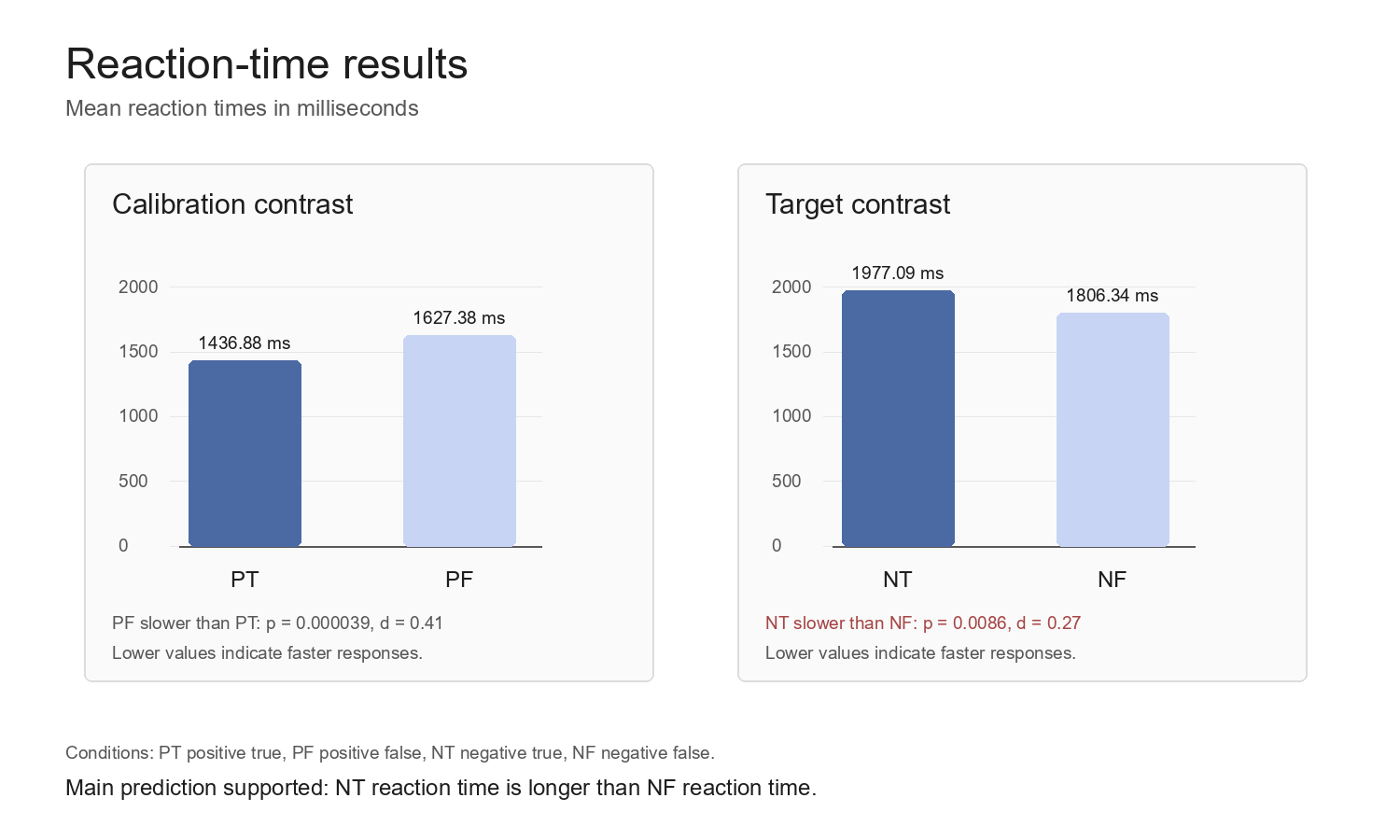
| PT meanRT: 1436.88 ms | NT meanRT: 1977.09 ms |
| PF meanRT: 1627.38 ms | NF meanRT: 1806.34 ms |
| Mean difference PT-PF: -190.51 ms | Mean difference NT-NF: 170.75 ms |
| Standard deviation: 461.46 | Standard deviation: 636.67 |
| Effect size: d = 0.41 (medium) | Effect size: d = 0.27 (small) |
| T-test: p = 0.000039 | T-test: p = 0.0086 |
Conference Poster
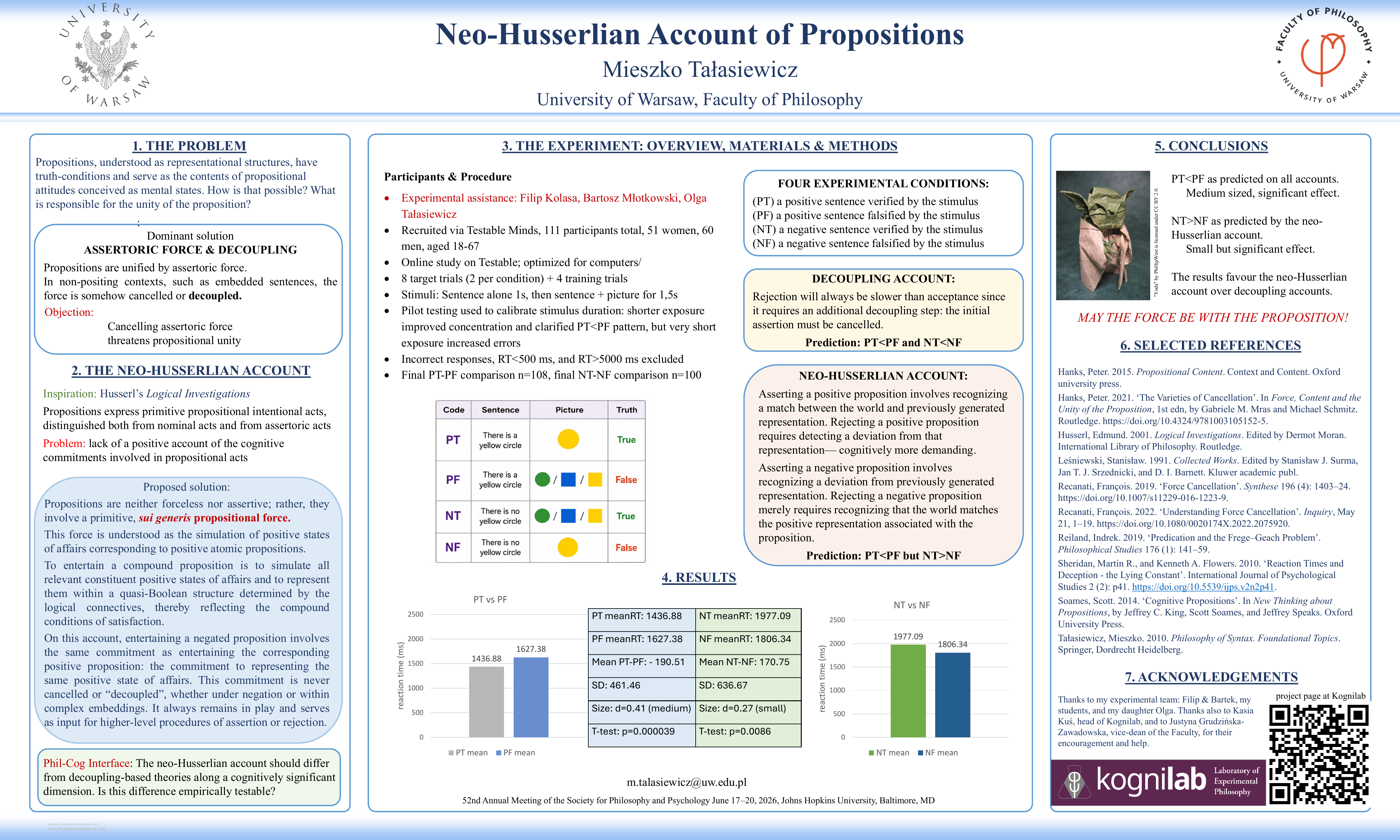
A conference poster presenting the experiment and results was prepared for the 52nd Annual Meeting of the Society for Philosophy and Psychology (SPP 2026), June 17-20, 2026, Johns Hopkins University, Baltimore, MD.
Conclusion
NT reaction time appears to be longer than NF reaction time, as predicted by the neo-Husserlian account. The effect is rather small but statistically significant.
References
The full project bibliography is available on the main project page.